What AI Can’t Replace: GOA Faculty on the Future of Assignment Design

Redesigning for AI isn't about outsmarting the technology. It's about noticing what a student needs from an assignment that AI can't supply: local lens, showing their own thinking behind a decision, and teachers who can empathize what it's like to be handed a powerful new tool with limited guidance on when and how to use it for learning. These were some of the highlights that came from GOA faculty on our Annual Faculty Camp discussion panels on the topic.
When Dee saw students short-cutting their thinking on standard economics prompts, she and her colleagues acknowledged that generic questions and invited generic answers. To shift the focus to genuine analysis, she overhauled a standard lesson on complementary goods. She asked students to build a full budget for a car their parents might buy, using real data from their own city: local insurance rates, area driver’s ed fees, and local pump prices.
The shift was immediate. Students couldn't rely on generic AI outputs because the assignment demanded hyper-local research and personal reflection. In GOA’s Educator Growth Framework, this is Design for Relevance. Dee kept the economic rigor intact, but raised the bar by making authentic student context the key to solving the problem.
Upgrade Tactics: Personalize the Assignment
Review an upcoming assignment: Would a quick AI query return a response indistinguishable from a general student response? Try swapping in a requirement for local data, personal reflection, or lived context that asks students to bring their own experiences and thinking to the task.
When Jacqueline noticed students using AI to shortcut their writing process, she knew banning it wouldn't stop the behavior, it would just hide it. She shifted away from only assessing the final text to seeking the student's inner dialogue in their writing process. She asked students to run their drafts through AI for a critique, with one firm boundary: AI could point out weak arguments, but it couldn't touch the phrasing. Students had to submit their AI conversation history alongside a brief rationale for every edit they accepted or rejected.
The shift was dramatic. Stripping away the ability to copy-paste forced students to do more deliberation while still empowering them to explore the technology. Students moved from passive users to active critical thinkers, explaining exactly where the AI failed to understand their voice. This exemplifies Teachers as Pedagogical Experts—redesigning the learning process so that transparent critical thinking becomes mandatory.
Upgrade Tactics: More Authentic Work
For an upcoming assignment, avoid default-mode by setting explicit guardrails around how and when students engage with AI tools. Require students to submit their process alongside their final work: the prompts they ran, the suggestions they received, and a quick defense of what they chose to accept, adapt, or reject.
Luis Carlos’s experience teaching Game Theory offers a critical reminder that as teachers we operate from a bedrock of experience, but students are still building theirs. What appears as a shortcut is often a student using a powerful tool without knowing what it costs their own growth. Designing with empathy gives assignments personal relevance, hooking students into doing the hard intellectual work that builds true mastery.
From Empathy into Action
Moving from an empathetic mindset to intentional design takes deliberate practice. At the end of Faculty Camp, every GOA teacher sets an annual growth goal to put these principles to work. AI was top of mind across the curriculum, surfacing in fresh commitments to rethink how students engage with technology.
Kristian Bodlay, AP Macroeconomics:
"This year, I will integrate more regular, low-stakes live check-ins and discussions into my schedule so I can uncover (and confirm) authentic student learning experiences, this will help me track my students' learning progression, and also help me ensure AI is used as a learning scaffold (students are leveraging it) rather than using it as a substitute for original thinking and true learning."
Ram Mahadevan, Cybersecurity:
"This term, I will use the AI Audit tool to systematically review and refine course assignments in Cybersecurity, strengthening opportunities for authentic learning, deeper thinking, and real-world application."
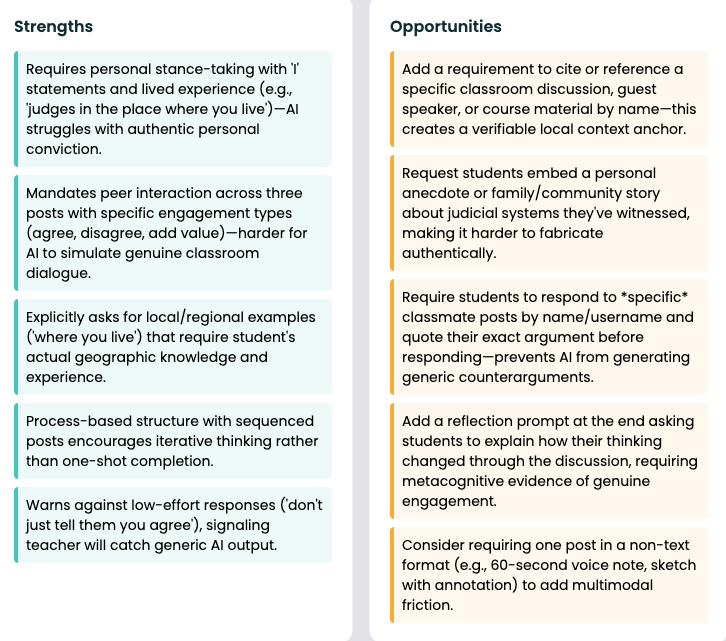
Across economics, discourse, game theory, and beyond, GOA faculty kept arriving at the same insight: the most effective response to AI isn't a better detection tool or a stricter policy. It's a better assignment. When a task asks students to bring their own city, their own reasoning, or their own voice, AI becomes one resource rather than a replacement for thinking. When teachers ensure the thinking process is visible, whether through AI conversation logs, live check-ins, or a quick defense of each choice, students learn not just the content but the judgment to use powerful tools well.
Dee, Jacqueline, and Luis Carlos didn't start with a finished playbook; they started by noticing what their students needed and adjusting from there. That same spirit runs through this year's growth goals, from Kristian's live check-ins to Ram's assignment audit to Dan's push for students to critique AI-generated reasoning. Each is a concrete step, and together they point toward a shared vision: classrooms where technology raises the bar for student thinking.
The question for educators this year is how our assignments give them a reason to think for themselves when they do. Pick one upcoming assignment, run it through the lens of relevance, transparency, and empathy, and see what changes.


