Who's Actually in the Room: Designing Week One Around Your Learners

The PLaybook - August 2026
By the time teachers open up their classrooms on day one, they often have collected a great deal of information about their incoming students. School files, parent/guardian forms, last year’s comments, and notes from previous teachers all describe who these students have been. But class dynamics have shifted, students have grown, and summer brings a lot of change that all that paperwork couldn’t possibly capture.
Being known as a student is not the same as being understood as a learner. This PLaybook will prepare your team for those first days back, with three approaches to help them learn more about their new students before the academic year is fully underway: a storytelling exercise for your faculty, an honest conversation about the age they teach, and fifteen minutes well spent with colleagues across grade levels.
What's inside this PLaybook
The core idea: before you can teach the content, you have to know who's in your class. This issue sits at the intersections of three domains of expertise in our Educator Growth Framework: development + pedagogy (Responsive Design) and development + content (Design for Relevance). Knowing your learners isn't a nice-to-have before teaching starts, it's the precondition for it.
July's PLaybook was about setting the year, and holding the big questions your leadership team faces as tensions to manage rather than sides to pick.
Did you use July's PLaybook and activities?
We used it Saved for later Not this one
Need a refresher? Revisit July's PLaybook ↗
Three activities to try
Learner Story Reflection
What do you wish your teachers had known about you?

Members of the GOA team shared their school photos from the past.
The prompt from this issue's opener, brought to your own team or faculty: find an old photo of yourself at the age you now teach, and answer: What were you into? What do you wish a teacher had known about you, or done differently? How would you design for you as a learner? What captured your attention in the classroom?
A teacher-to-student opportunity: Ask your team to consider what questions they might ask their new students in the first few days of class. How could they incorporate those questions in an opening writing assignment, a brief reflection after the first assignment or assessment, a student interview, or a coaching conversation. Encourage your faculty to share their own story as a learner with their students (and, if they’re brave…their photo). It's a low-lift way to make "developmentally appropriate" feel personal instead of abstract, and it surfaces real stories about your students quickly.
Know Their Developmental Moment
What's actually going on with this age group right now, and what does that mean for week one?
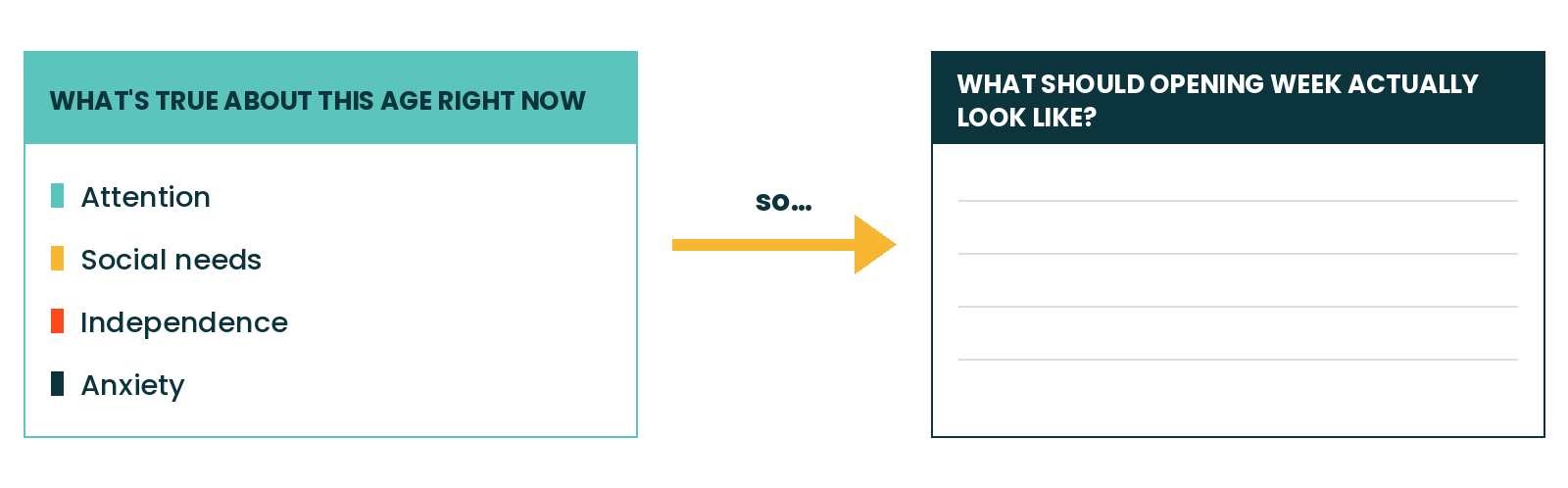
As a grade-level or department team, spend real time on the developmental science of the age you teach, not a refresher you already know, but a conversation about it out loud. What's true right now about this age's attention, social needs, independence, anxiety?
Then ask them to work forward: Given your response, what should opening week actually look like? This is also a good moment to talk about rites of passage, annual opening assignments, the ways your school (or others in the network) mark the transition into a grade or division for different ages, and to think about which ones are still doing the real work of surfacing who your students are right now versus which ones are just tradition.
Cross-Grade Handoff
Where did this class actually leave off?
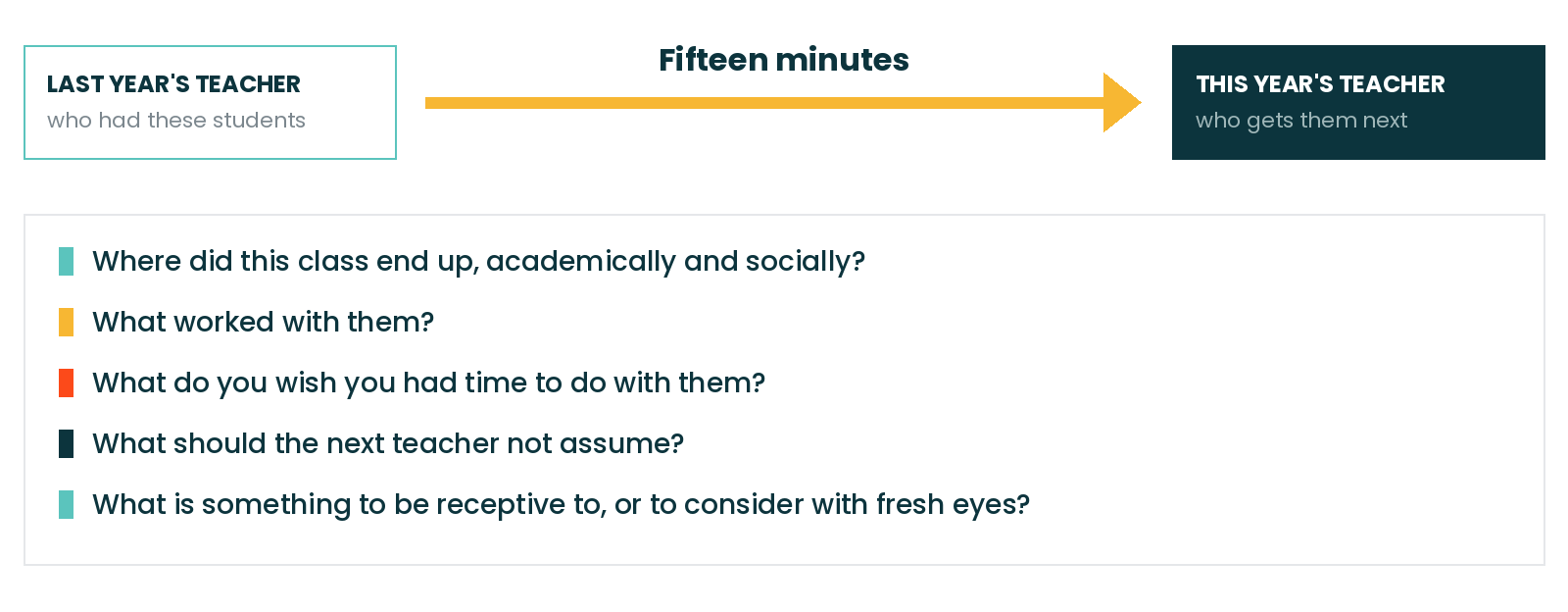
Before the year starts, pair outgoing and incoming teachers for the same group of students, for example, sixth grade teachers talking to fifth grade teachers, or last year's Algebra I teacher talking to this year's Geometry teacher. For fifteen minutes, discuss: where did this class end up, academically and socially? What worked with them? What do you wish you had time to do with them? What should the next teacher not assume? What is something to be receptive to, or to consider with fresh eyes? This is a small, concrete way of doing the "rewind" instead of just intending to.
Slides for your first meeting
We've put all three activities into one slide deck you can use at your first team meeting.
See this in practice
To kick off 8th Grade Social Studies taught by Kathleen Brown at Holland Hall (OK), students will create a video game avatar that visually captures their current strengths, habits, and mindset as a historian and student. Rather than depicting a future goal, this profile serves as a baseline snapshot of who they are as a scholar right now. Later in the year, students will revisit and update their avatar's design to reflect their academic growth and evolving skills.
GOA Faculty member Kristian Bodlay (Investing I, Microeconomics) asks students these questions at the start of every year: How do you learn best? What would you like me to do? What does success look like for you, and how can I support you this semester so you feel supported and successful?
Learn more about how we get to know our students as learners at GOA.
This month's PLaylist: Getting to know who's actually in the room
- Transitioning Young Adolescents from Elementary to Middle School (AMLE). This article grounds the "rewind" idea in what's actually changing developmentally at grade transitions.
- Planning Back-to-School Meetings: Advice From 3 Principals (Edutopia). The article shares ideas for bringing a developmental lens into your first leadership or faculty meeting.
- 6 Challenging Trends for Middle Schools (AMLE). This article provides additional context on how quickly the "typical" student profile can shift year to year.
- How to Get to Know Your Students As Learners (GOA). This post shares three practices for understanding how your students learn, from week-one questions to quick check-ins.


