Coaching Moves That Shift Practice

The PLaybook - October 2026
“Be curious, not judgmental.” When I coached a GOA teacher this summer, I tried to live that line: ask questions before giving advice, offer feedback while it can still make a difference, and keep students at the center. I haven’t mastered it, but I keep starting again with curiosity.
Alejandra (Ale) Cantu
High School Dean of Students at American School Foundation of Monterrey, and GOA Faculty Member
This month’s PLaybook turns Alejandra’s insights into three coaching practices:
- Bring One Thing helps your team reflect together through questions, not advice.
- The Same-Day Feedback Note helps leaders follow a classroom visit with timely, specific feedback.
- The Quick Student Pulse gives teachers the opportunity to learn from students.
What's inside this PLaybook
By mid-fall, instructional leaders are in the thick of coaching, and coaching comes in more than one form. We start with a reflection protocol you can run in your next department or grade-level meeting. Then we look at coaching in two more relationships: leader to teacher, with a focus drawn from GOA's Educator Growth Framework, and student to teacher. We close with a quick AI-assisted tool for turning observation notes into a follow-up the same day.
September's PLaybook was about putting the process next to the product, with ways to show families and visitors how student work came together, not just the finished piece.
Did you use September's PLaybook and activities?
We used it Saved for later Not this one
Need a refresher? Revisit September's PLaybook ↗
Why this matters now
Elena Aguilar, an instructional coach and author of The Art of Coaching, has helped how school leaders approach coaching conversations. In her model, the most effective coaches give feedback in small, incremental pieces, pairing an observed strength with the just-right next step. She also argues that coaches should be thought partners who help teachers problem-solve and strategize, not experts who simply tell them what to do. Kim Marshall, author of Rethinking Teacher Supervision and Evaluation, adds a practical twist: follow each brief classroom visit and conversation with a short summary. The goal is feedback you can deliver quickly that is specific enough to actually shift practice.
GOA's own faculty point to the same need. In Still Working On It: Feedback, AI, and the Conversations Faculty Want, teachers' loudest request was for time to talk with each other about their practice. Teachers also want feedback that is specific, timely, and part of an ongoing conversation, not a once-a-year event.
Three activities to try
Coaching doesn't only happen one classroom or course visit at a time. These activities move from reflecting together as a team, to feedback from a leader, to feedback from students.
Bring One Thing
What does our work so far this year tell us about student learning?
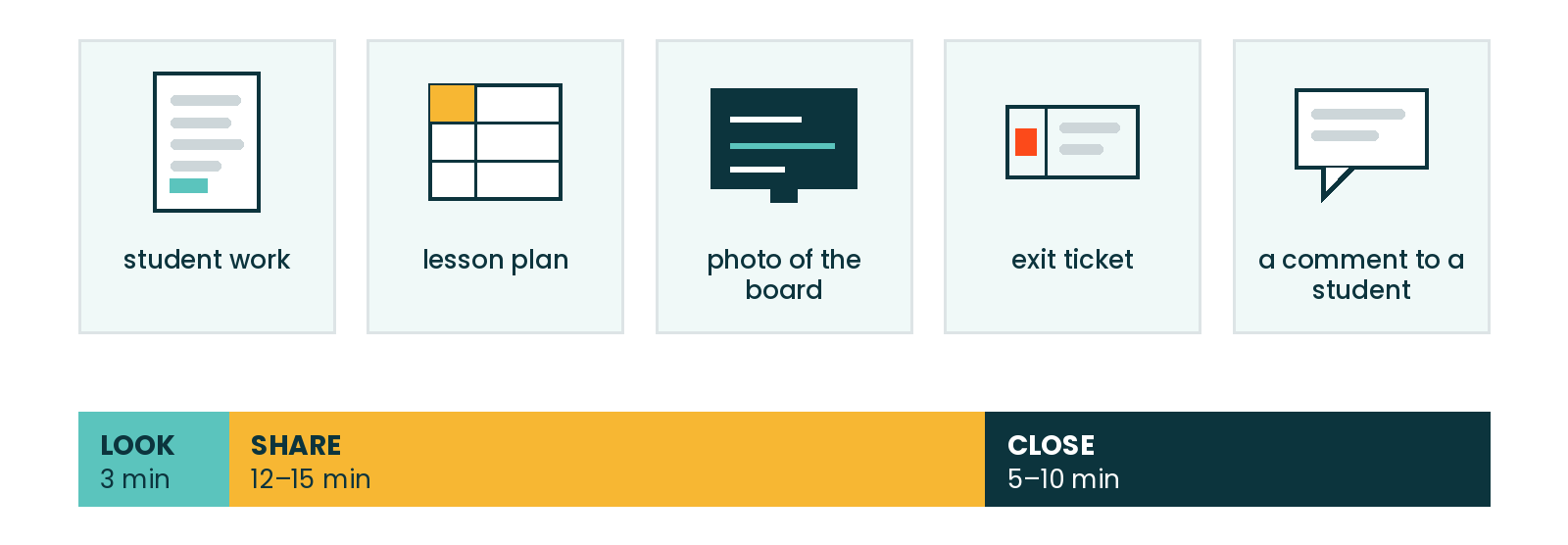
Before your next department or grade-level meeting, ask each teacher to bring one artifact. It could be a piece of student work, a lesson plan, a photo of the board, an exit ticket, or a comment they gave a student. In 20–30 minutes:
- Look (3 minutes): everyone jots down why they chose their artifact.
- Share (12–15 minutes): in groups of three, each person spends two minutes explaining their artifact. Colleagues respond with questions, not advice.
- Close (5–10 minutes): as a whole group, name the patterns you notice and one thing each person wants to try next.
The leader collects the patterns, which become a picture of where the team is and what to focus on in subsequent team meetings.
The Same-Day Feedback Note
What's the one thing this teacher should hear from me today?
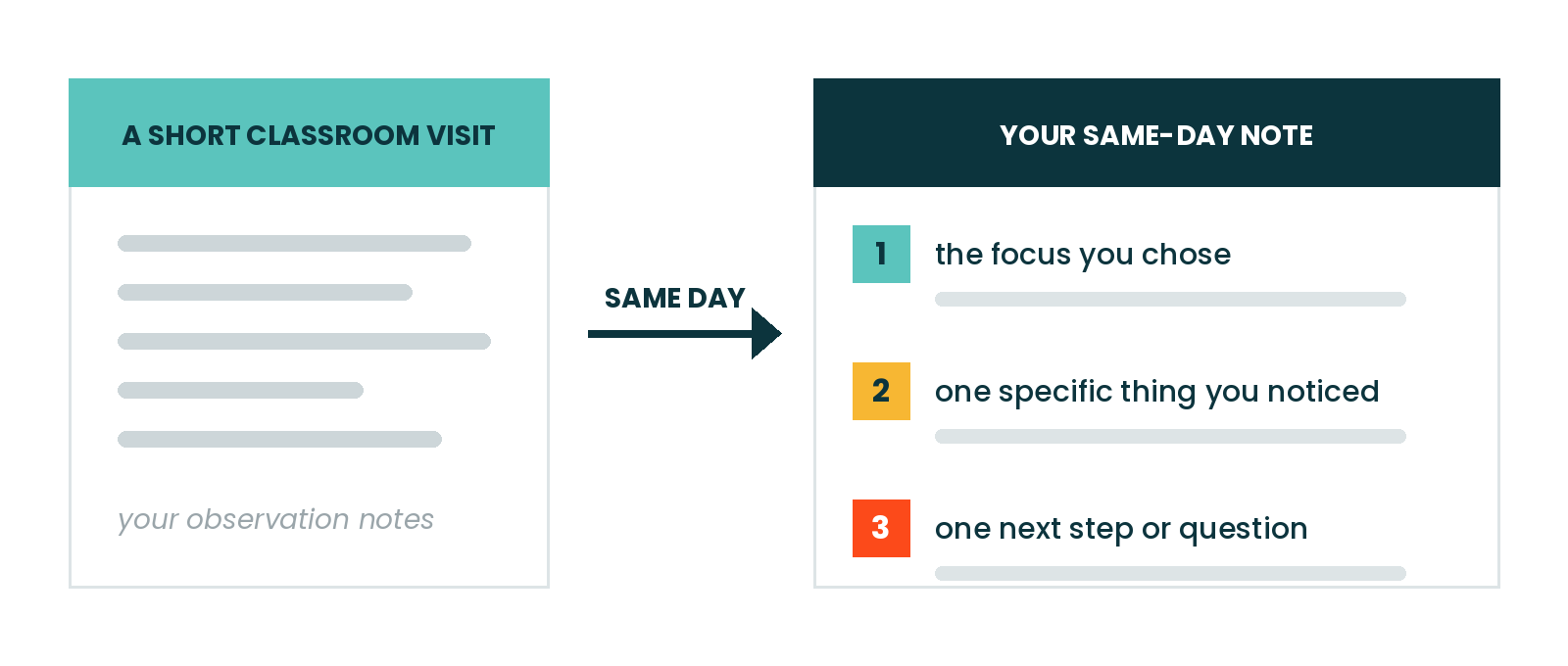
After a short classroom visit, write a note with three parts:
- the focus you chose
- one specific thing you noticed
- one next step or question
Send it the same day. A note that arrives while the lesson is still fresh does more than a thorough write-up that arrives two weeks later. Start by thanking the teacher for opening their classroom. If the lesson was strong, the whole note can be appreciations.
Need a focus? Choose one of three intersections from GOA's Educator Growth Framework before you walk in, and use its growth conversation prompt word for word or adapt it for your next step.
- Design for Relevance (Content + Developmental): "You have deep content expertise and genuine passion for your discipline. Let's explore how to make that content feel urgent and personally meaningful to these specific students. How can we help them see themselves in this work?"
- Design for Understanding (Content + Pedagogical): "Your content knowledge is really strong. Let's focus on how you're translating that understanding into learning experiences. What are the key conceptual building blocks students need, and how can you design tasks that make their developing understanding visible?"
- Responsive Design (Developmental + Pedagogical): "You're strong at reading students emotionally, and you have great pedagogical range. Let's work on connecting those two. How can you use what you notice about students' readiness to decide which instructional approach to use in the moment?"
AI-Assisted Observation Synthesis
How do I turn my notes into useful feedback before the moment passes?
One instructional leader found a way to shorten the gap between observing and following up. They took a photo of their handwritten observation notes, gave it to an AI tool, and got back a one-page summary of the key takeaways to share with the teacher that day. The teacher thanked them for the fast follow-up.
Three rules for using this tool:
- Use a school-approved AI tool.
- Remove names and identifying details.
- Read and edit everything before you send it.
I observed a class for about 30 minutes. My notes are attached. Our coaching focus is [Design for Relevance / Design for Understanding / Responsive Design]. Draft a short follow-up note to the teacher, under 150 words, that:
- thanks them for opening their classroom,
- names two specific things from my notes that connect to this focus, and
- ends with one question or next step based on this growth conversation prompt: [paste prompt from Activity 2].
Use a warm, collegial tone. Don't evaluate or score the lesson, and don't add anything that isn't in my notes.
Focus: Design for Understanding
Thank you for having me in your class today. It was great to see students so engaged in their small-group discussions.
What I noticed
- Before the discussion, you had students do a two-minute quick write. As you circulated, you used what you saw to decide which groups to join first.
- When a student gave a short answer, you asked, "What makes you say that?" That pushed the group to explain their reasoning, not just state a conclusion.
One question to consider
What are the two or three key ideas you want students to leave this unit understanding? How could the quick writes help you check for those ideas specifically? I'd love to hear your thoughts whenever you have 10 minutes.
The Quick Student Pulse
What are my students telling me about how this class is working for them?
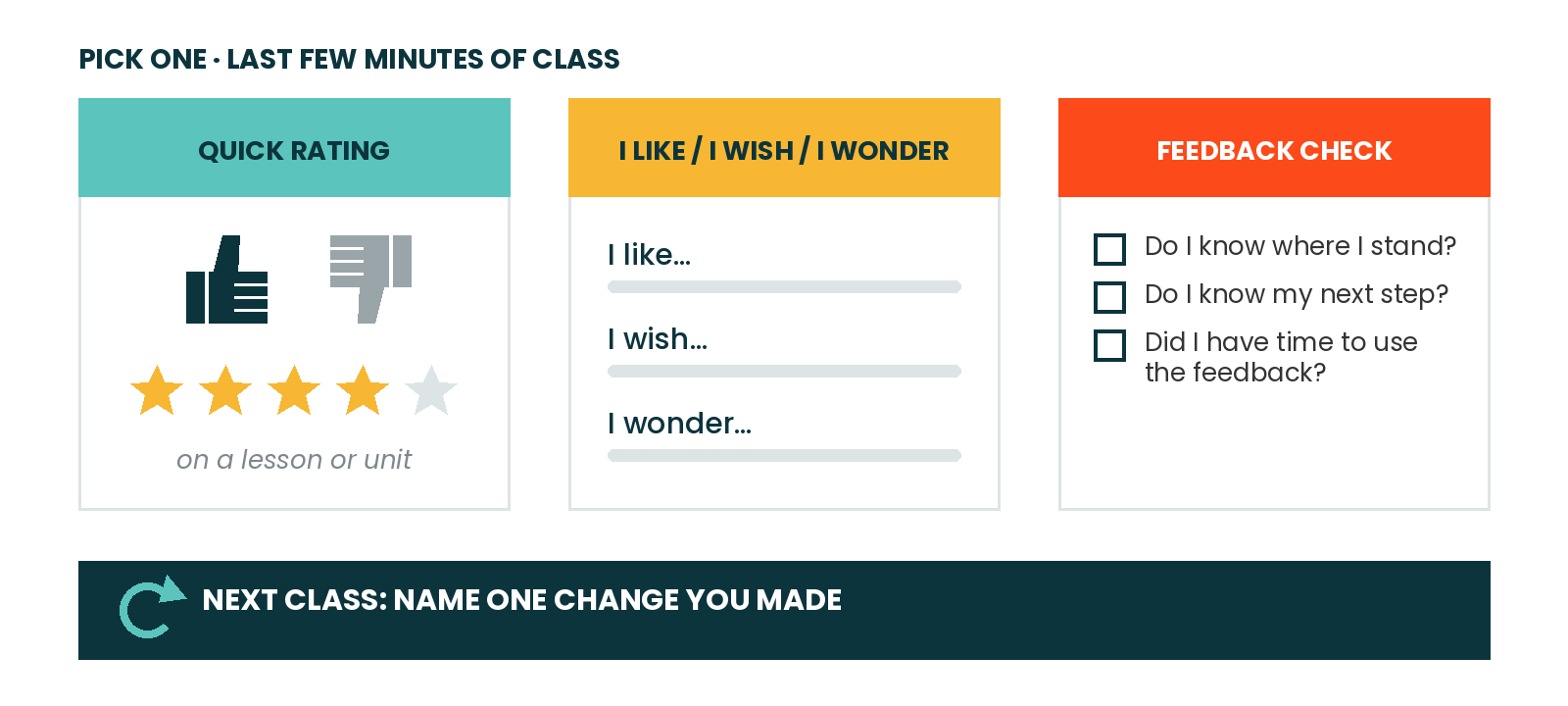
Pick one quick check from this menu and run it in the last few minutes of class:
- Quick rating: a thumbs up or down, or a star rating on a lesson or unit.
- I like / I wish / I wonder: one sentence each.
- Feedback check: three quick yes/no questions. Do I know where I stand? Do I know my next step? Did I have time to use the feedback my teacher gave me?
Then the teacher should close the loop at the next class by naming one change they made because of what students shared. Students keep giving honest feedback when they see it lead to changes.
This month's PLaylist
- How Do We Cultivate a Coaching Culture at Our Schools and Organizations? (GOA). This post shares coaching strategies that build connection and psychological safety for leaders, coaches, and teachers.
- Effective Feedback for Teachers After an Observation (Edutopia). This article argues that a short face-to-face conversation after an observation beats a written note, and that feedback on a strong lesson can be 100 percent appreciation.
- Early and Mid-Semester Student Feedback (Columbia Center for Teaching and Learning). This is a practical guide to gathering student feedback early in a course, including the Start, Stop, Continue method and a bank of questions that takes you to a six-page PDF. It's written for college courses but can be adapted to K–12 classrooms.


